

55 years manufacturing. ISO 9001:2015 certified. Government-recognized Star Export House.
Exported to 20+ countries. Here's why buyers choose us — and keep coming back.
POWERFORGE vs. The Field
The spec sheet is where most manufacturers stop. We go further — into the metal, the tolerances, the surface finishes, and the engineering decisions that determine whether an engine runs for 3,000 hours or 15,000. Here's what's inside.
✦ Specifications are from POWERFORGE engine technical documentation. Competitor characteristics reflect typical unbranded or low-cost agricultural diesel engines in the Indian and export markets. Competitor characteristics are representative, not brand-specific.
Six Parts. Six Reasons.
Every specification in that table is an engineering decision with a consequence. Here's what each one means for the engine running your field, your generator, or your borehole at 5 AM.
A Crankshaft That Won't Crack Under Pressure
Cast iron is cheap. Forged alloy steel is what survives. In a single-cylinder engine running at 1,500–3,000 RPM under variable agricultural load — PTO engagement, hydraulic pump surge, sudden throttle changes — the crankshaft absorbs every shock. Forged steel has a directional grain structure from the forging process that makes it orders of magnitude more resistant to fatigue fracture than cast alternatives. We balance every crankshaft both statically and dynamically. Our competition often doesn't even specify which material they use.
Three Rings Doing Three Jobs — Not Two Compromising
The top compression ring is the hardest-working component in any piston engine. It seals 50+ bar of combustion gas while running against the bore at 4–6 m/s mean piston speed. Ours is chrome-faced — a surface treatment that triples abrasive wear resistance in the dust-laden air of agricultural environments. Below it: a plain intermediate ring backs up compression. Third: a coil-spring-loaded oil scraper ring whose spring keeps constant contact with the liner wall regardless of ring wear, wiping oil back cleanly for the engine's full service life. Two-ring budget packs try to do all three jobs with two rings and fail at all of them.
The Surface Finish That Determines Your Engine's Life
Most engine failures don't begin with a broken part. They begin with a worn cylinder wall. The liner surface finish — measured in Ra (arithmetic mean roughness) — determines how well your oil film holds under load. At Ra 0.4 µm, our wet-type cast-iron liners have a precision cross-hatch that traps oil between peaks while allowing the ring to seat correctly during run-in. Rough-honed liners at Ra >1.0 µm accelerate ring wear, raise blow-by, and increase oil consumption from the first operating hour. The difference is invisible to the eye and decisive over 5,000 hours of field use.
Hardened Seats. Interference Guides. No Compromise.
Two failure chains kill valve trains in field conditions. First: seat recession — the valve face repeatedly impacts an unhardened insert and, over thousands of cycles, the seat sinks into the head. Hardened inserts resist this, especially with high-sulphur fuels common across Africa, South Asia, and the Middle East. Second: guide shift — a loose-fit guide migrates under thermal cycling, changing stem clearance, causing oil burning, carbon buildup, and valve float that kills compression. Our interference-fit guides are pressed in under controlled force to maintain exact position through the engine's full service life. Both failure chains are engineered out before the engine ships.
150–180 Bar — Where Power Actually Comes From
Diesel combustion quality is dictated by one factor above all others: how finely fuel is atomised at injection. Finer droplets mean more surface area, faster evaporation, more complete combustion. Our mechanical jerk-type pump delivers 150–180 bar at the nozzle — timed at 23°–26° BTDC at a compression ratio of 17.5:1–18.5:1. Budget engines run 100–120 bar at lower compression. You see the difference in the exhaust: black smoke is unburned fuel leaving as loss. We burn it instead. The result is more power per litre of diesel, less carbon fouling on injector tips, cleaner exhaust, and longer nozzle service intervals.
Oil to the Bearings in 2 Seconds — Not 15
Splash lubrication is simple: a paddle on the connecting rod flings oil around the crankcase. It is also the primary wear mechanism of budget engines under continuous-duty agricultural cycles. Startup is the most critical moment — bearing surfaces have no oil film until the engine moves. Our gear-driven pressure pump delivers oil to main bearings and big-end bearings within two seconds of cold cranking. Splash systems take fifteen. That 13-second dry-running window — repeated every morning across a crop season — is what separates a 3,000-hour engine from a 12,000-hour one.
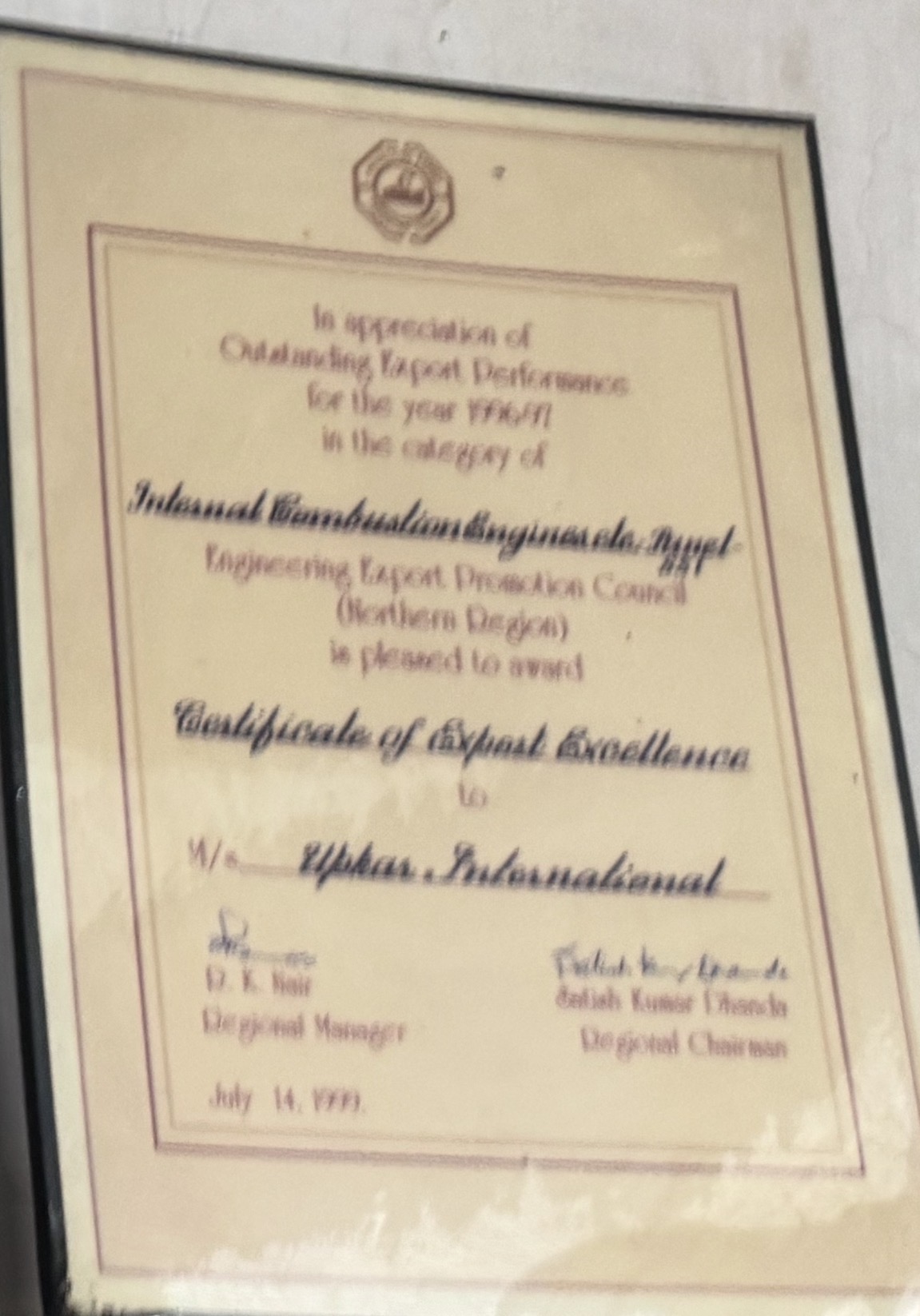
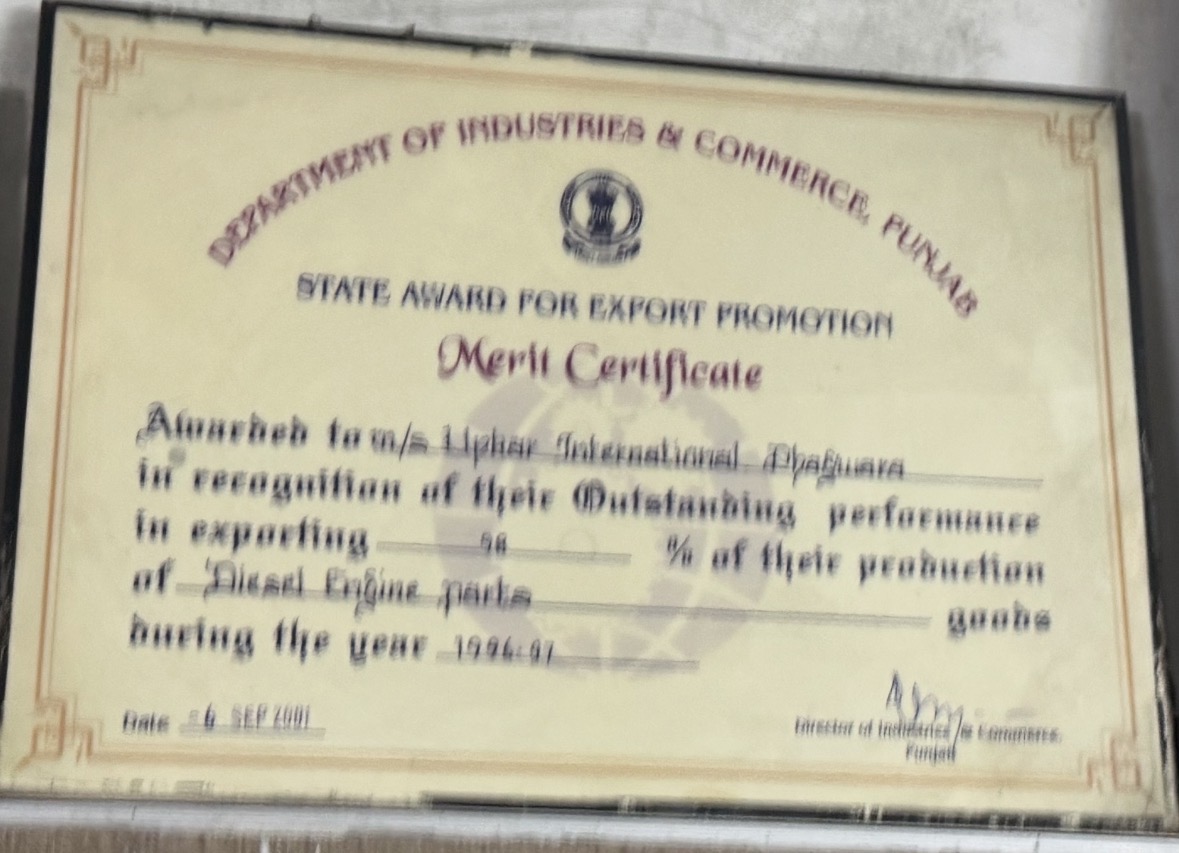
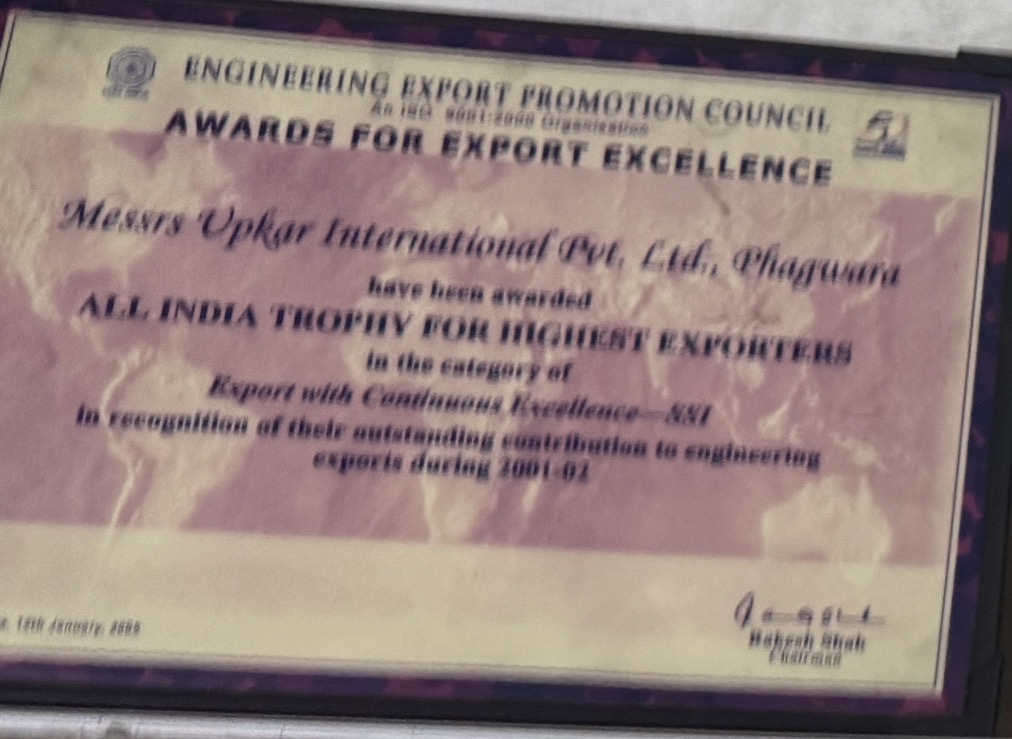
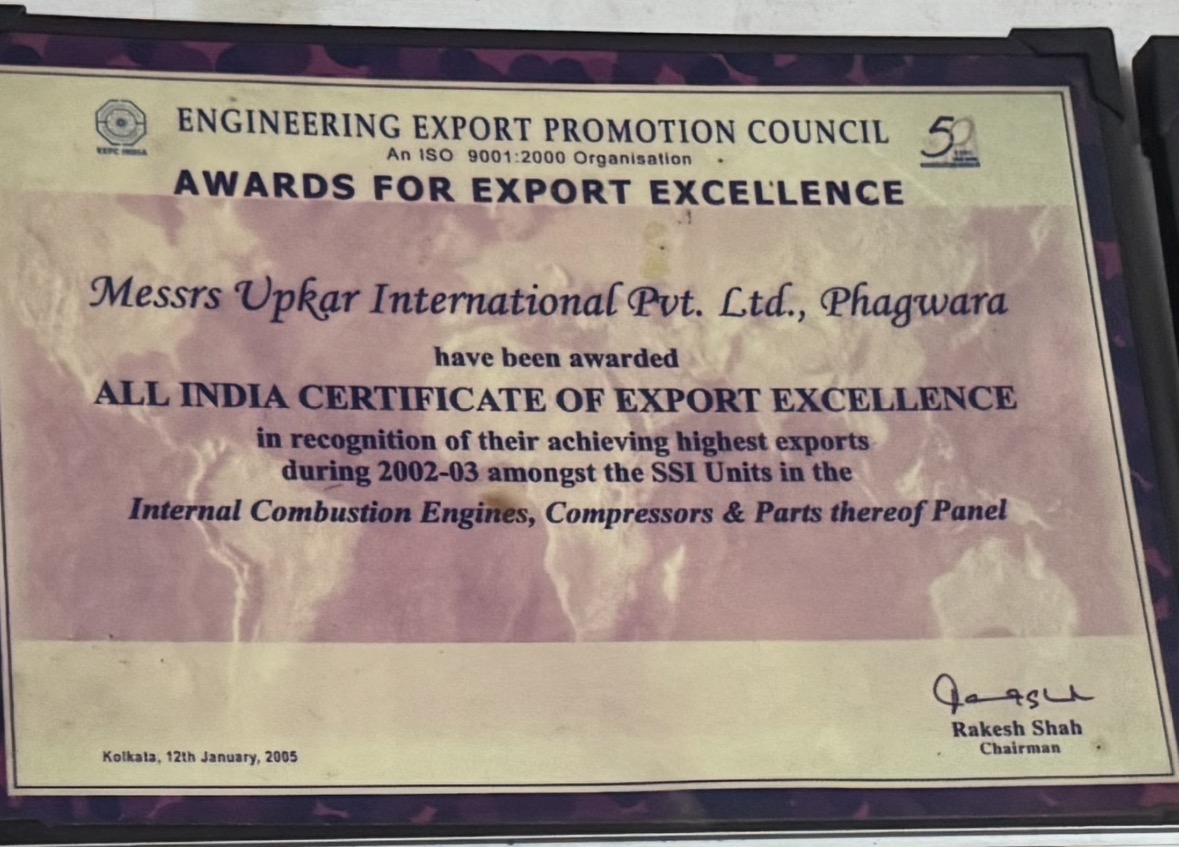
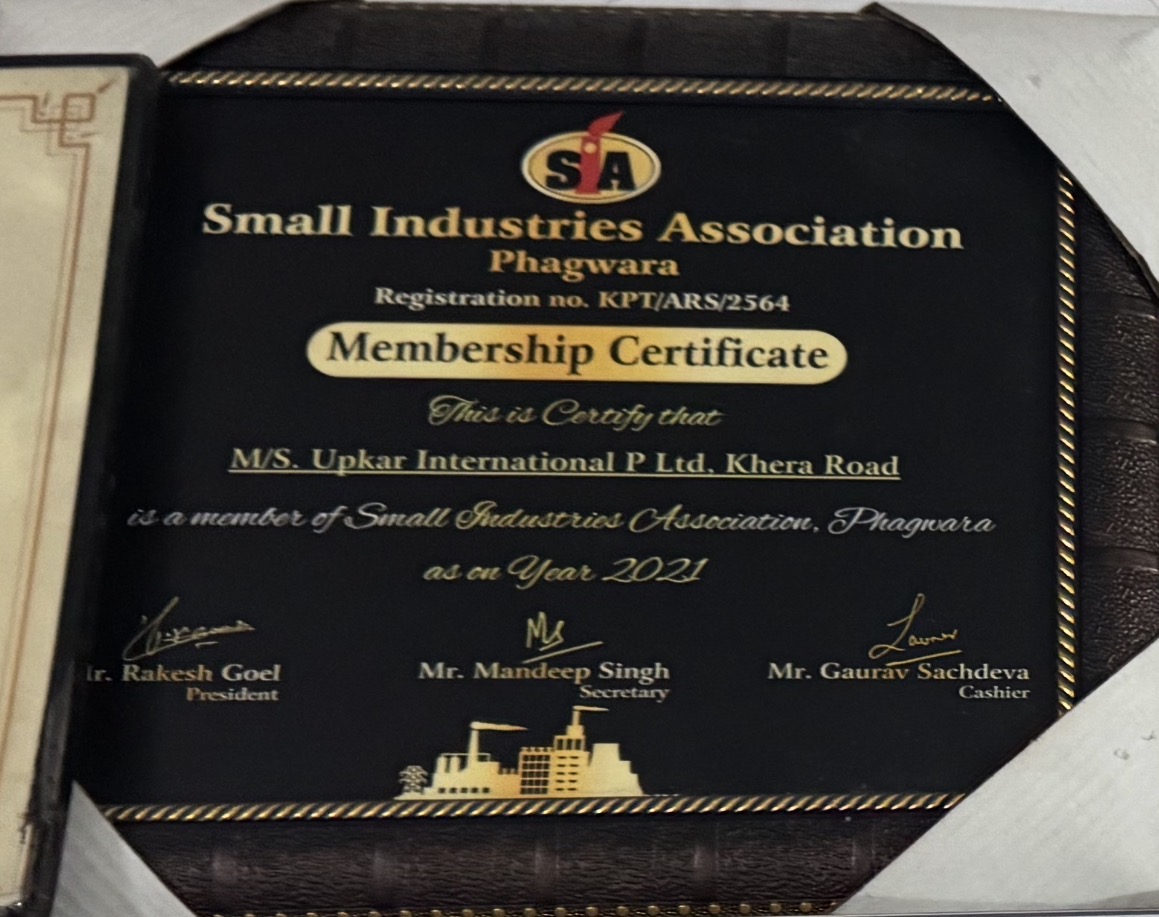
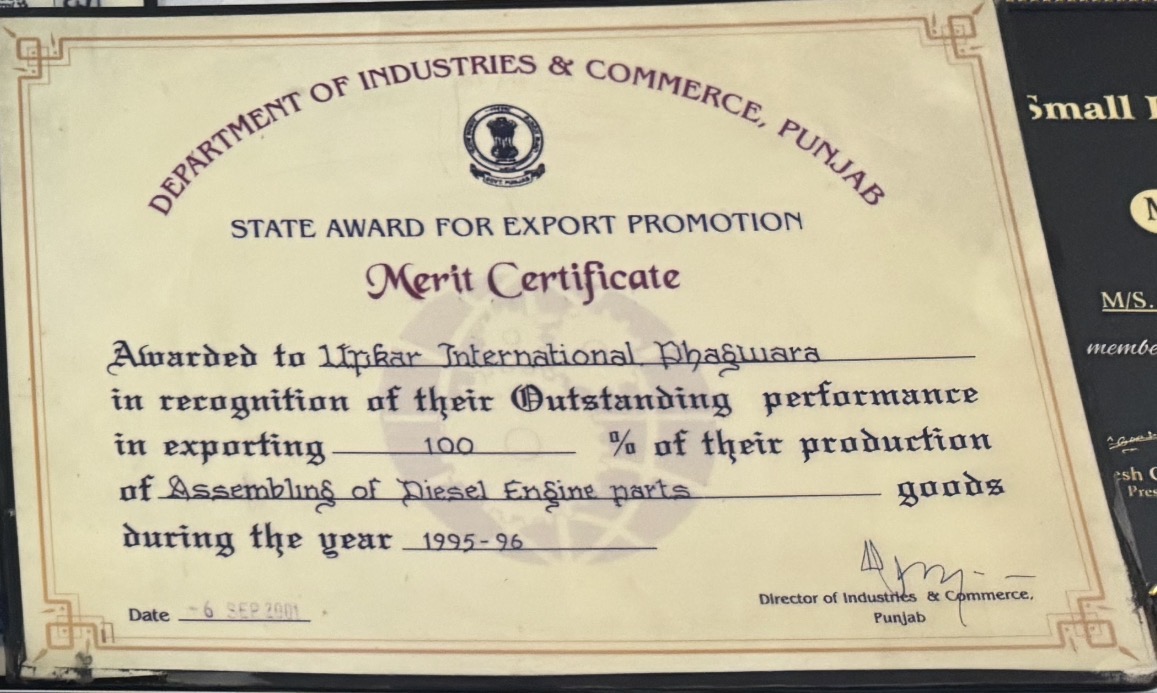
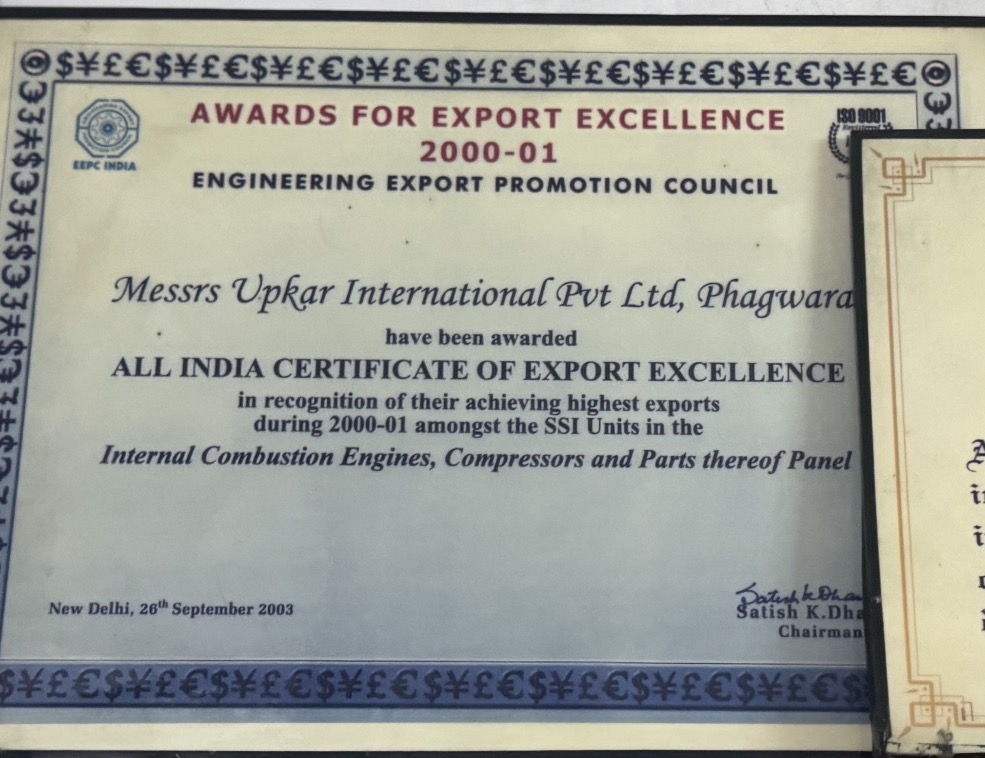
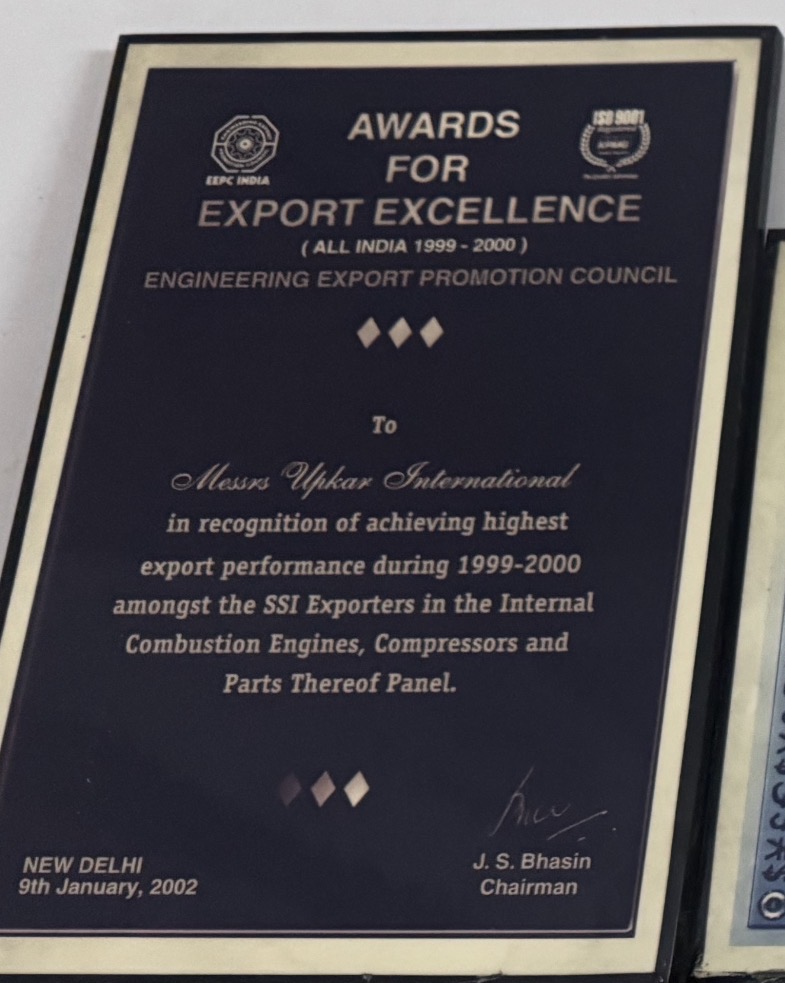
The Certificates. Not Just the Claims.
Every certification we carry was earned — audited, inspected, and renewed. These are the documents that separate a manufacturer you can stake your business on from one you can't.
Built Here. Trusted Everywhere.
Our factory on Khera Road, Phagwara has been running since 1970. Drop-forging, precision machining, endurance testing, export-grade packing — the same floor that made your grandfather's engine is still making yours.
In an industry full of re-badged parts and uncertified claims,
one manufacturer has built its reputation on 55 years of proof.
When your harvest depends on an engine starting at 5 AM, when your contractor's deadline rides on a genset that cannot fail, when an export container needs equipment that will clear every compliance check in 20 countries — you don't gamble on a brand you found last week. You call the manufacturer that governments have recognized, that global markets have validated, and that five decades have tested without a single recall.
PARTNER WITH UPKAR.
Our export desk handles commercial enquiries across 20+ countries. Share your requirement — we respond within one business day with full specifications, FOB pricing, and packing details.